
Key Takeaways
Executive education has always moved slower than the industries it serves — a strange irony for institutions whose whole purpose is preparing people for change. That's shifting, not because universities suddenly became agile, but because AI tools have quietly slipped into three specific parts of the process: how work gets assessed, how credentials get verified, and how a curriculum adapts to the person taking it. None of it looks dramatic from the outside. All of it changes what a doctoral or executive programme actually feels like to go through.
Grading and Feedback Are Getting Faster, Not Necessarily Deeper
The most visible change is turnaround time. Work that used to sit in a supervisor's queue for two or three weeks — a draft chapter, an applied project, a case analysis — can now get a first pass of structured feedback within days, with AI tools flagging structural issues, citation gaps, or unclear argumentation before a human reviewer ever opens the document.
This is a genuine improvement for working professionals specifically, because the biggest cost of a slow feedback loop isn't the wait itself — it's the momentum you lose juggling a doctorate around a full-time role. Faster first-pass feedback means less time spent stalled, waiting to know whether you're on the right track before you can move to the next section.
What hasn't changed — and shouldn't — is who makes the final call on academic quality. The tools flag and suggest; a qualified supervisor still decides whether the argument holds up. Any programme that's replaced that judgment entirely with automated scoring has cut a corner worth asking about before you enrol.
Credential Verification Is Becoming Nearly Instant
This is the least glamorous change and arguably the most useful one. Verifying a doctoral or Master's credential used to mean an employer or third party writing to a registrar's office and waiting — sometimes weeks — for a confirmation letter. Digital verification systems have collapsed that into something closer to real time: a link, a record, a confirmed match, no waiting on office hours in a different time zone.
For anyone earning a credential specifically to strengthen their professional standing, this matters more than it first appears to. A degree that's hard to verify quickly is a degree that creates friction exactly at the moment it's supposed to be opening a door — a job offer, a board appointment, a licensing check. Techversity's own verification page exists for precisely this reason: so a credential earned through one of our partner universities can be confirmed by any third party without the old multi-week back-and-forth.
Personalised Learning Paths — Real, But Ask What's Actually Behind the Term
"Personalised learning" has become one of those phrases that shows up on almost every programme's marketing page, and not all of it means the same thing. In its genuine form, it means the sequence and depth of material actually adjusts based on what you already know and what you're struggling with — skipping ahead where you're already strong, slowing down and offering more support where you're not.
In its weaker form, it just means you can choose which order to watch pre-recorded videos in, which is convenience, not personalisation. Neither is dishonest, exactly, but they're not the same thing, and it's worth asking a programme directly what adapts and what doesn't before assuming the term means real-time responsiveness to your progress.
| Traditional Approach | AI-Enabled Approach | |
|---|---|---|
| Assignment feedback | Manual review, often 2–3 week turnaround | AI-assisted first pass within days, human final review |
| Credential verification | Manual request to registrar, multi-week wait | Digital verification, near-instant confirmation |
| Curriculum sequencing | Fixed order for all students | Adjusts based on demonstrated strengths and gaps, where genuinely adaptive |
| Final academic judgment | Human supervisor or committee | Still human — this hasn't shifted, and shouldn't |
“The honest way to describe what's changed is this: AI has made the administrative and mechanical parts of executive education faster. It hasn't made the thinking part easier — and any programme implying otherwise is selling something other than a real credential.”
The Skill That Isn't Getting Automated
Every one of these shifts — faster feedback, instant verification, adaptive sequencing — speeds up the process around the learning. None of them replace the actual reason a senior professional pursues a doctorate or executive credential in the first place: developing the judgment to synthesise ambiguous, incomplete information into a decision you can defend. That's still built through original research, supervised discussion, and the friction of being challenged by someone qualified to challenge you — and it's the one part of the process no tool has meaningfully shortened, because it isn't supposed to be short.
What This Means If You're Choosing a Programme Right Now
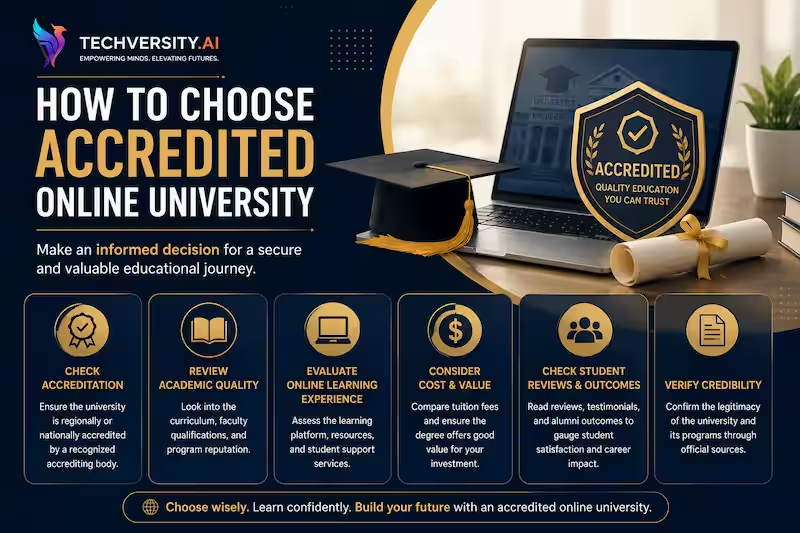
Ask direct questions instead of taking the marketing language at face value: how fast is feedback actually turned around, and by whom. How is a credential verified after the fact, and by whom. What does "personalised" adapt, specifically. The answers will tell you more about the quality of a programme than any AI-related buzzword on its landing page — and they're the same questions a Techversity advisor can walk you through for any of our partner universities before you commit.
Next Step
Not sure which pathway fits your background?
A short advisory call is usually faster than reading every comparison guide — tell us where you are, and we'll tell you honestly what fits.
Talk to an Advisor