Key Takeaways
Honorary doctorates have an image problem they didn't fully earn. For every university that has conferred one on a genuine industry leader for decades of documented contribution, there's a website selling one for $299 with same-day approval and no questions asked. The confusion between the two is exactly what illegitimate providers count on — and exactly what this guide is meant to clear up.
What an Honorary Doctorate Actually Is
An honorary doctorate — often written Honoris Causa — is a degree awarded by a university without the recipient completing the usual coursework, research, or examinations. It exists to formally recognise exceptional professional achievement, public service, or contribution to a field. Universities have awarded these for centuries, typically to individuals whose career accomplishments already function as evidence of the expertise a degree is meant to certify.
Crucially, it is conferred — not applied for and passed. A legitimate institution reviews your professional record, decides whether it meets their bar for recognition, and either proceeds or declines. There is no 'failing' an honorary doctorate application in the way you'd fail an exam, but there is absolutely a review, and it can end in 'not at this time.'
What It Is Not
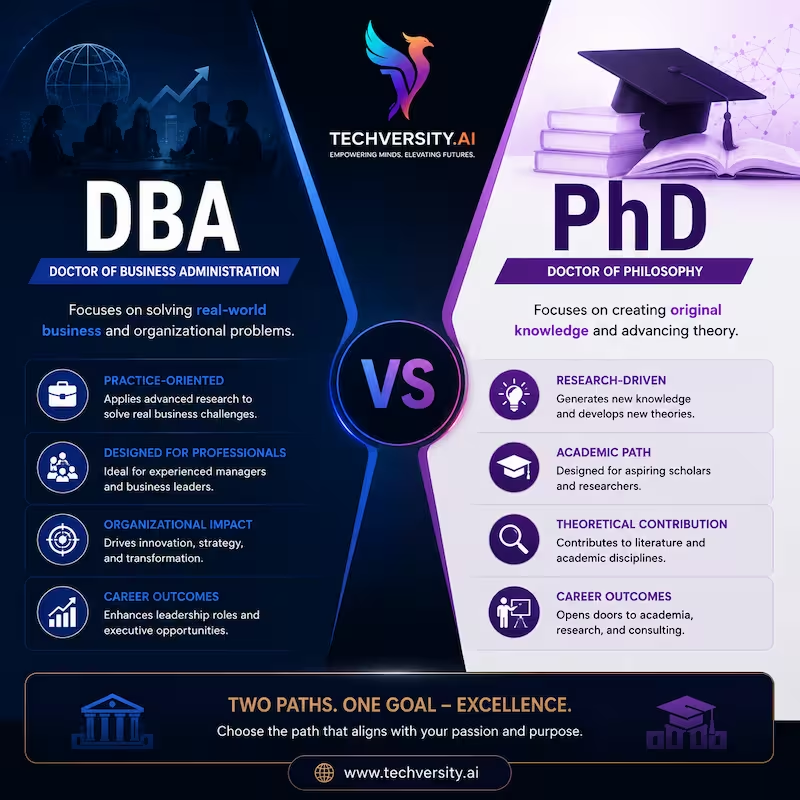
An honorary doctorate is not a substitute for an earned PhD or DBA. It doesn't certify that you completed doctoral-level research, and it should never be used to imply that you did. Reputable institutions are explicit about this distinction in the documentation they issue alongside the title.
- It does not qualify you to practice medicine, law, or any other licensed profession.
- It does not automatically carry the same weight as an earned doctorate in academic or scientific hiring contexts.
- It should not be presented in a way designed to make people assume you completed a PhD-level program.
Red Flags of an Illegitimate Provider
The clearest warning signs are speed and certainty. If a website promises guaranteed approval, same-day issuance, or a title with 'no review process,' that's not a shortcut — it's the entire business model. A genuine recognition process takes real evaluation time, because it's supposed to mean something.
- No visible review committee, evaluation criteria, or timeline before approval.
- The same site also sells 'fake diplomas' or 'novelty degrees' as a separate product line.
- No accreditation is mentioned, or the accreditation body itself can't be verified independently.
- Aggressive pricing tiers that seem to correlate with how fast you want the certificate, not with anything else.
- Marketing language that encourages you to use the title in ways the institution itself hasn't authorised.
“A real honorary doctorate takes time to earn a reputation for. A fake one takes a credit card.”
How to Verify an Institution Before You Apply
This part takes about ten minutes and should never be skipped, no matter how credible a provider sounds.
- Search the accrediting body named on the institution's site directly — don't just trust a badge or logo.
- Check whether the accreditor itself is recognised by a government or international quality-assurance authority.
- Look for a named academic review process, criteria, or committee — not just a payment page.
- Ask directly what documentation you'll receive and what it does and doesn't entitle you to say or do.
- If in doubt, ask an independent education advisor to check the institution's standing before you commit anything.
Can You Use the Title 'Dr.' Afterwards?
Generally, yes — recipients of a legitimate honorary doctorate may use the title in professional and academic settings, consistent with the conferring institution's guidelines. The honest practice is to note it's an honorary conferral where relevant (many recipients note 'Hon.' alongside the title on formal documents), rather than let people assume it was earned through coursework and examination.
Our Take
An honorary doctorate from a properly accredited institution is a genuine, respected form of recognition — it simply isn't the same instrument as an earned doctorate, and no reputable provider will tell you otherwise. The credential is only as good as the institution behind it, so the ten minutes of verification isn't optional diligence — it's the entire difference between recognition and regret.
Next Step
Not sure which pathway fits your background?
A short advisory call is usually faster than reading every comparison guide — tell us where you are, and we'll tell you honestly what fits.
Talk to an Advisor